performance / Strength
The OSU Football Power Routine: Simple Strength Training That Works
A direct breakdown of the seven-set OSU Power Routine, including the complete loading chart, upper- and lower-body reps, an example workout, and how to progress it.
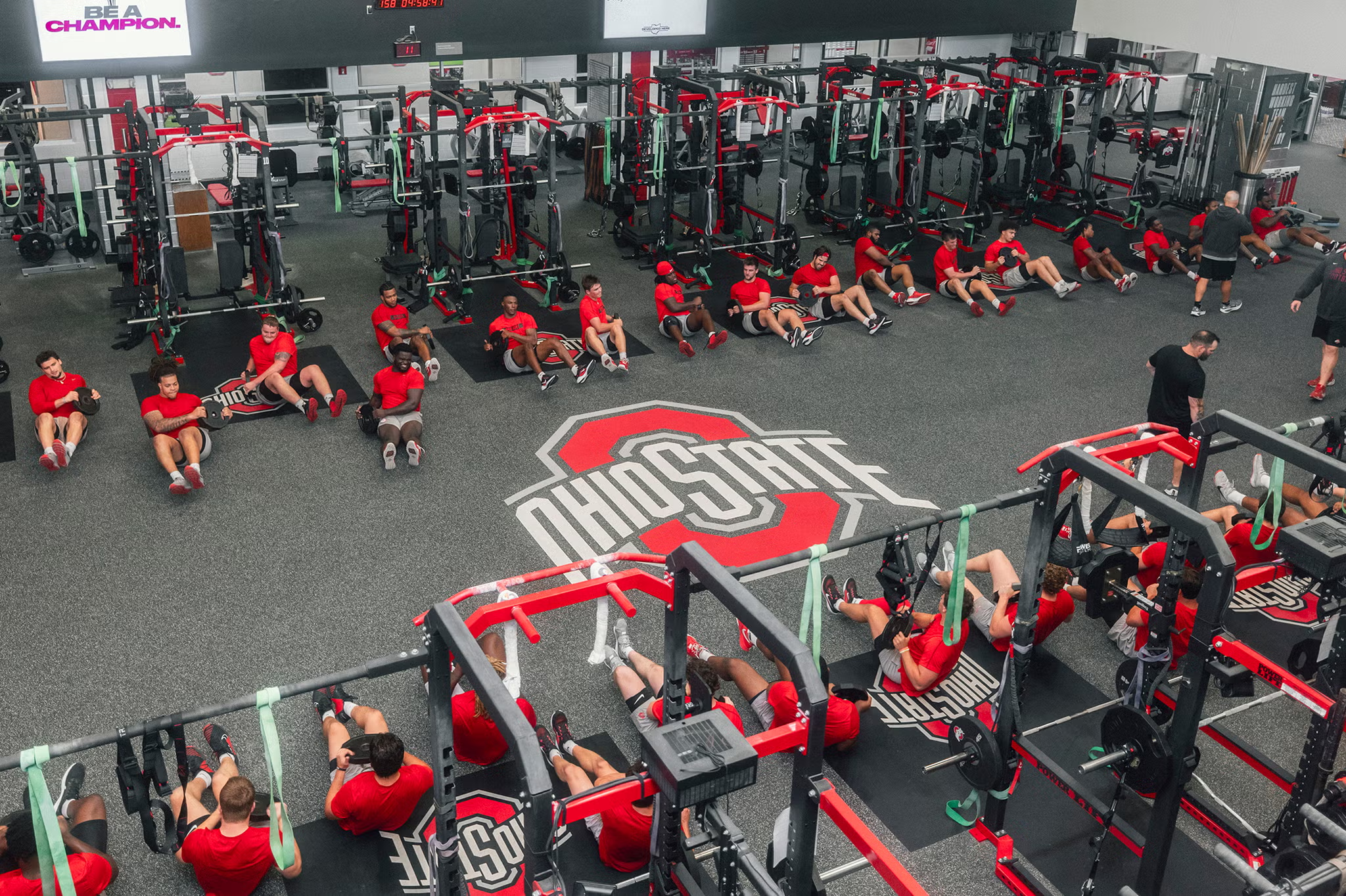
The OSU Power Routine is a seven-set loading ladder. For upper-body lifts, the reps are 8, 6, 4, 3, 2, 1, and 4. For lower-body lifts, they are 10, 8, 6, 4, 2, 1, and 6. Pick your MAX column from the original chart and use the listed weight for every set. That is the answer.
There is no secret exercise, complicated spreadsheet, or revolutionary periodization model hiding behind the sheet. You enter with an honest max, climb through six increasingly heavy sets, and finish with a hard backoff set. It is simple enough for a room full of football players to follow and demanding enough to build real strength.
My opinion is straightforward: most lifters would make better progress with this one sheet than with the overbuilt programs they keep rewriting every two weeks. The routine removes guesswork. What it does not remove is effort.
The Routine at a Glance
| Set | Upper-body reps | Lower-body reps |
|---|---|---|
| 1 | 8 | 10 |
| 2 | 6 | 8 |
| 3 | 4 | 6 |
| 4 | 3 | 4 |
| 5 | 2 | 2 |
| 6 | 1 | 1 |
| 7 | 4 | 6 |
The original OSU Power Routine sheet lists maxes from 50 to 640 pounds in 10-pound increments and gives the working weight for each set. I rebuilt the complete chart as a clean five-page PDF so you can print it, take it to the gym, and read every number without squinting at the original photocopy.
View the complete weight chart below.
If your max falls between two columns, use the lower column. This sheet is a lookup chart, not a clean percentage calculator, so use the printed weights instead of trying to reverse-engineer them.
Example With a 300-Pound Max
If your current max is 300 pounds, this is the workout:
| Set | Weight | Upper body | Lower body |
|---|---|---|---|
| 1 | 200 lb | 8 reps | 10 reps |
| 2 | 220 lb | 6 reps | 8 reps |
| 3 | 240 lb | 4 reps | 6 reps |
| 4 | 260 lb | 3 reps | 4 reps |
| 5 | 270 lb | 2 reps | 2 reps |
| 6 | 280 lb | 1 rep | 1 rep |
| 7 | 240 lb | 4 reps | 6 reps |
That is a serious workout. The early sets build useful volume, the middle sets force you to stay technically sound as the bar gets heavy, the single gives you practice handling near-max weight, and the final backoff set makes you produce clean reps after fatigue has already accumulated.
Do not call the first high-rep set a warmup. Ten lower-body reps at the listed weight is work. You should already be warm before the seven listed sets begin.
Why This Simple Routine Works
The genius of this routine is not novelty. It is the order.
You earn the heavy weight
The program does not let you walk into the gym, load the heaviest weight, and hope your body figures it out. You climb through four increasingly heavy sets first. By the time you reach the double and single, your joints are warm, your technique is rehearsed, and your nervous system knows what movement it is performing.
You practice strength without maxing out
A heavy single demands focus. Strength is a skill, and the listed single gives you practice setting up, bracing, and finishing a lift without turning every workout into a reckless personal-record attempt.
If the single becomes a grinder every week, your MAX column is too high or your recovery is bad. The answer is not more motivation. The answer is to stop lying to the chart.
The final set exposes fake strength
The backoff set is the part I like most. Plenty of lifters can survive one ugly heavy rep. Coming back down to the chart’s final weight and producing four upper-body reps or six lower-body reps shows whether you actually own the weight.
That last set also forces technique under fatigue, which matters for athletes. Football is not one perfect effort performed in a quiet room after a five-minute rest. You have to produce force again after you have already worked.
Use an Honest Max or the Program Falls Apart
Your input controls the entire workout. Use the max you can perform today with clean, repeatable form. Do not use the number you hit three years ago, the rep your spotter deadlifted off your chest, or the squat that stopped six inches above depth.
If your real max is 300 but you enter 330 because it sounds better, the routine becomes a weekly failure test. You will miss reps, butcher technique, and blame the program for your ego.
I would rather see someone use a slightly conservative training max and dominate every set than use an inflated number and turn the last half of the workout into assisted reps.
How I Would Run It
The paper gives us the loading chart. It does not give us the entire weekly schedule, exercise list, rest periods, accessory work, or progression rules. Anyone claiming those details came from this one sheet is making them up.
Here is how I would use it in the real world:
- Use it for one main lift per workout. This is for the lift you are trying to make stronger, not curls, lateral raises, or every machine in the gym.
- Start with one upper-body and one lower-body exposure per week. Bench press and squat are the obvious choices. Earn the right to add more work.
- Perform separate warmup sets first. Use the empty bar and a few low-percentage jumps. Do not waste energy, but do not jump cold into the listed work.
- Rest two to three minutes on the first three sets. Take three to five minutes before the heavy double and single if you need it.
- Stop failed reps before they happen. The listed single should be heavy and clean, not a ten-second survival attempt.
- Add weight only after the entire workout is controlled. My rule would be two clean sessions before adding 5 pounds to an upper-body max or 10 pounds to a lower-body max.
That progression rule is my recommendation, not something printed on the OSU sheet. It is intentionally conservative because strength programs work through accumulated successful sessions, not constant testing.
What This Routine Is Not
This is not the complete Ohio State football strength and conditioning program. It is a loading routine. A full football program would also account for sprinting, jumping, Olympic-lift variations, position demands, practice volume, conditioning, injuries, and the time of year.
It is also not a beginner program. New lifters do not need weekly near-max work. They can add weight with much simpler linear progression while practicing technique at lower intensities.
Finally, it is not permission to run the same seven-set ladder on five different barbell lifts in one session. One main lift done hard is productive. Repeating near-max work until your technique collapses is just bad planning.
Who Should Use It
This routine makes sense for an intermediate or advanced lifter who:
- Knows a legitimate one-rep max
- Can repeat the main lift with consistent technique
- Wants a simple strength day without excessive accessory volume
- Recovers well enough to handle a weekly heavy single
- Will follow the listed weights instead of improvising based on emotion
If you are beat up from sport practice, cutting weight, sleeping five hours a night, or returning from an injury, move to a lower MAX column before you start. A printed chart does not know how recovered you are.
The Bottom Line
The OSU Power Routine works because it makes the athlete do the basics in the right order: accumulate reps, climb to heavy weight, handle a controlled single, and prove it with a final backoff set.
The routine is not too simple. Most people are too inconsistent.
Pick an honest max. Follow the seven sets. Keep the reps clean. Add weight only when you have earned it. Do that for months instead of hunting for a new program every Monday, and you will get stronger.
Complete lookup chart
All weights from 50 to 640
Find your MAX column, then follow the seven rows from top to bottom. Every number is a working weight in pounds.
MAX 50 to 160
Working weights in pounds| Upper reps | Lower reps | MAX50 | MAX60 | MAX70 | MAX80 | MAX90 | MAX100 | MAX110 | MAX120 | MAX130 | MAX140 | MAX150 | MAX160 |
|---|---|---|---|---|---|---|---|---|---|---|---|---|---|
| 8 | 10 | 20 | 30 | 40 | 50 | 60 | 60 | 70 | 70 | 80 | 80 | 90 | 100 |
| 6 | 8 | 20 | 30 | 40 | 50 | 70 | 70 | 80 | 80 | 90 | 90 | 100 | 110 |
| 4 | 6 | 30 | 40 | 50 | 60 | 70 | 70 | 80 | 80 | 90 | 100 | 110 | 120 |
| 3 | 4 | 30 | 40 | 60 | 60 | 80 | 80 | 90 | 90 | 100 | 100 | 110 | 120 |
| 2 | 2 | 40 | 50 | 60 | 70 | 80 | 80 | 90 | 100 | 110 | 110 | 120 | 130 |
| 1 | 1 | 40 | 50 | 60 | 70 | 90 | 90 | 100 | 110 | 120 | 120 | 130 | 140 |
| 4 | 6 | 30 | 40 | 50 | 60 | 70 | 70 | 80 | 80 | 90 | 100 | 110 | 120 |
MAX 170 to 280
Working weights in pounds| Upper reps | Lower reps | MAX170 | MAX180 | MAX190 | MAX200 | MAX210 | MAX220 | MAX230 | MAX240 | MAX250 | MAX260 | MAX270 | MAX280 |
|---|---|---|---|---|---|---|---|---|---|---|---|---|---|
| 8 | 10 | 110 | 120 | 130 | 140 | 140 | 150 | 160 | 170 | 170 | 180 | 180 | 190 |
| 6 | 8 | 120 | 130 | 140 | 140 | 150 | 160 | 170 | 180 | 180 | 190 | 190 | 200 |
| 4 | 6 | 130 | 140 | 140 | 150 | 160 | 170 | 180 | 190 | 200 | 210 | 210 | 220 |
| 3 | 4 | 130 | 140 | 150 | 160 | 170 | 180 | 180 | 190 | 200 | 210 | 210 | 220 |
| 2 | 2 | 140 | 150 | 160 | 170 | 180 | 190 | 200 | 210 | 220 | 230 | 230 | 240 |
| 1 | 1 | 150 | 160 | 170 | 180 | 190 | 200 | 210 | 220 | 230 | 240 | 250 | 260 |
| 4 | 6 | 130 | 140 | 140 | 150 | 160 | 170 | 180 | 190 | 200 | 210 | 210 | 220 |
MAX 290 to 400
Working weights in pounds| Upper reps | Lower reps | MAX290 | MAX300 | MAX310 | MAX320 | MAX330 | MAX340 | MAX350 | MAX360 | MAX370 | MAX380 | MAX390 | MAX400 |
|---|---|---|---|---|---|---|---|---|---|---|---|---|---|
| 8 | 10 | 200 | 200 | 210 | 210 | 220 | 230 | 240 | 240 | 240 | 250 | 250 | 260 |
| 6 | 8 | 210 | 220 | 230 | 230 | 240 | 250 | 260 | 270 | 280 | 280 | 290 | 290 |
| 4 | 6 | 230 | 240 | 250 | 260 | 270 | 280 | 280 | 290 | 300 | 310 | 310 | 320 |
| 3 | 4 | 250 | 260 | 270 | 280 | 290 | 300 | 310 | 320 | 330 | 340 | 350 | 360 |
| 2 | 2 | 260 | 270 | 280 | 290 | 300 | 310 | 320 | 330 | 340 | 350 | 360 | 370 |
| 1 | 1 | 270 | 280 | 290 | 300 | 310 | 320 | 330 | 340 | 350 | 360 | 370 | 380 |
| 4 | 6 | 230 | 240 | 250 | 260 | 270 | 280 | 280 | 290 | 300 | 310 | 310 | 320 |
MAX 410 to 520
Working weights in pounds| Upper reps | Lower reps | MAX410 | MAX420 | MAX430 | MAX440 | MAX450 | MAX460 | MAX470 | MAX480 | MAX490 | MAX500 | MAX510 | MAX520 |
|---|---|---|---|---|---|---|---|---|---|---|---|---|---|
| 8 | 10 | 260 | 270 | 270 | 280 | 280 | 290 | 300 | 310 | 310 | 320 | 330 | 330 |
| 6 | 8 | 300 | 300 | 310 | 310 | 320 | 320 | 330 | 340 | 340 | 350 | 360 | 360 |
| 4 | 6 | 330 | 330 | 340 | 340 | 350 | 360 | 370 | 370 | 380 | 390 | 390 | 400 |
| 3 | 4 | 370 | 370 | 380 | 390 | 400 | 410 | 410 | 420 | 430 | 440 | 450 | 460 |
| 2 | 2 | 380 | 390 | 400 | 410 | 420 | 430 | 440 | 450 | 460 | 460 | 470 | 480 |
| 1 | 1 | 390 | 400 | 410 | 420 | 430 | 440 | 450 | 460 | 470 | 480 | 490 | 500 |
| 4 | 6 | 330 | 330 | 340 | 340 | 350 | 360 | 370 | 370 | 380 | 390 | 390 | 400 |
MAX 530 to 640
Working weights in pounds| Upper reps | Lower reps | MAX530 | MAX540 | MAX550 | MAX560 | MAX570 | MAX580 | MAX590 | MAX600 | MAX610 | MAX620 | MAX630 | MAX640 |
|---|---|---|---|---|---|---|---|---|---|---|---|---|---|
| 8 | 10 | 340 | 340 | 350 | 350 | 360 | 360 | 370 | 380 | 390 | 390 | 400 | 400 |
| 6 | 8 | 370 | 380 | 390 | 390 | 400 | 410 | 410 | 420 | 430 | 440 | 450 | 460 |
| 4 | 6 | 400 | 410 | 420 | 430 | 430 | 440 | 450 | 460 | 460 | 470 | 480 | 490 |
| 3 | 4 | 470 | 480 | 490 | 500 | 510 | 510 | 520 | 530 | 540 | 560 | 570 | 580 |
| 2 | 2 | 490 | 500 | 510 | 520 | 530 | 540 | 550 | 560 | 570 | 580 | 590 | 600 |
| 1 | 1 | 510 | 520 | 530 | 540 | 550 | 560 | 570 | 580 | 590 | 600 | 610 | 620 |
| 4 | 6 | 400 | 410 | 420 | 430 | 430 | 440 | 450 | 460 | 460 | 470 | 480 | 490 |